

Cork and Clare anchor the current public story.
Name
Name, meaning, and forms
The main Irish form in the current research is Ó Luanaigh. Patrick Woulfe described it as a Munster surname, chiefly found in Cork and Clare, and explained it as descendant of Luanach. Woulfe connects Luanach with luan, glossed as warrior or champion.
The public site uses O'Luanaigh as a readable English-language project name, while preserving Irish forms where they belong. Gaois lists Ó Luanaigh, Uí Luanaigh, and Ní Luanaigh, and maps English-language surnames including Looney, Loney, Lunney, and O'Looney to the same Luanach entry.
Several English spellings overlap across sources, including Looney, O'Looney, Lowney, Loney, Loony, and Lunney. Some sources distinguish Munster Ó Luanaigh from Ulster Ó Luinigh, so this project treats variant spellings as research leads rather than proof of a single family origin.
Places
Places in the evidence
The strongest current sources place Ó Luanaigh in Munster, especially Cork and Clare. That is the safest starting point for the public narrative.
Kerry appears as a secondary Munster distribution lead, but not yet as a core origin claim. Tyrone and Muintir Loney material are tracked separately because the current evidence points first to an Ulster Ó Luinigh comparison track, not automatically to Munster Ó Luanaigh.
Tracked as a secondary distribution signal.
Raphoe, Tyrone, Muintir Loney, and Fermanagh remain on the Ó Luinigh track.
Census, valuation, parish, townland, and diaspora research belong to the next layer.
Folklore

Folklore collected by bearers of the name
Dúchas preserves Co. Clare Schools' Collection material gathered by named bearers of the Irish form Ní Luanaigh. Treasa Ní Luanaigh appears as a collector in Cloonadrum / Mullagh material, and Máiréad or Mairéad Ní Luanaigh appears as a collector in Gortown / Kilshanny material. One item also names Bríghid Ní Luanaigh as an informant.
The topics are local rather than surname-specific: fairy forts, holy wells, old sayings, footwear customs, smithing, humorous tales, local history, place-name legend, and Biddy Early folklore.
These records connect bearers of the name with folklore collection in 1930s Clare. They do not yet prove folklore about the surname or family itself.
Brian

Brian Ó Luanaigh / Brian O'Looney
Brian Ó Luanaigh, also known as Brian O'Looney (1828-1901), was a Co. Clare Celticist, manuscript scholar, editor, translator, and Irish-language revival figure. Born near Ennistymon, he copied and edited Irish-language manuscripts, published work on Clare bardic poetry, became a member of the Royal Irish Academy, taught Irish language and literature at the Catholic University, and helped found the Society for the Preservation of the Irish Language.
His life gives the Ó Luanaigh name a documented place in nineteenth-century Irish scholarship and language revival. This project includes him as a notable bearer of the name, not as evidence of a direct family connection.
Mark

A family-associated mark
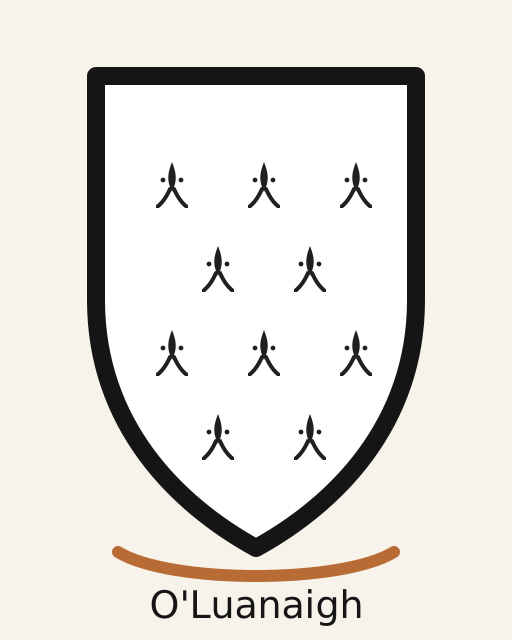
The research archive includes a Looney / O'Luanaigh crest reference image long associated with the user's family. First-pass verification did not find a formal blazon, named armiger, branch, grant, confirmation, or official register entry for the exact design.
For that reason, the website identity uses a simplified interpretive shield mark inspired by the family-associated reference. The mark is not presented as verified arms, and the site does not imply surname-wide heraldic entitlement.
Sources

Sources and acknowledgements
This project separates confirmed sources, useful leads, and family tradition. Public claims are kept close to the evidence, and uncertain claims stay visible as questions.
Core sources for the first draft include Patrick Woulfe's Irish Names and Surnames, Gaois surname data, the Dictionary of Irish Biography, Dúchas / the National Folklore Collection, National Library of Ireland catalogue records, and the project's own source quality rubric.
Commercial surname and crest pages are treated as leads only. They are not used as proof of origin, genealogy, arms, or entitlement.
Later

Later genealogy work
Detailed family-line genealogy is intentionally outside the first public version. The next genealogy lane should begin with record sets such as the 1901 and 1911 census, Griffith's Valuation, civil records, parish registers, tithe applotment books, and estate papers where relevant.
That work will need exact variant spellings, target counties, and personal family details before it can responsibly move beyond surname-level research.